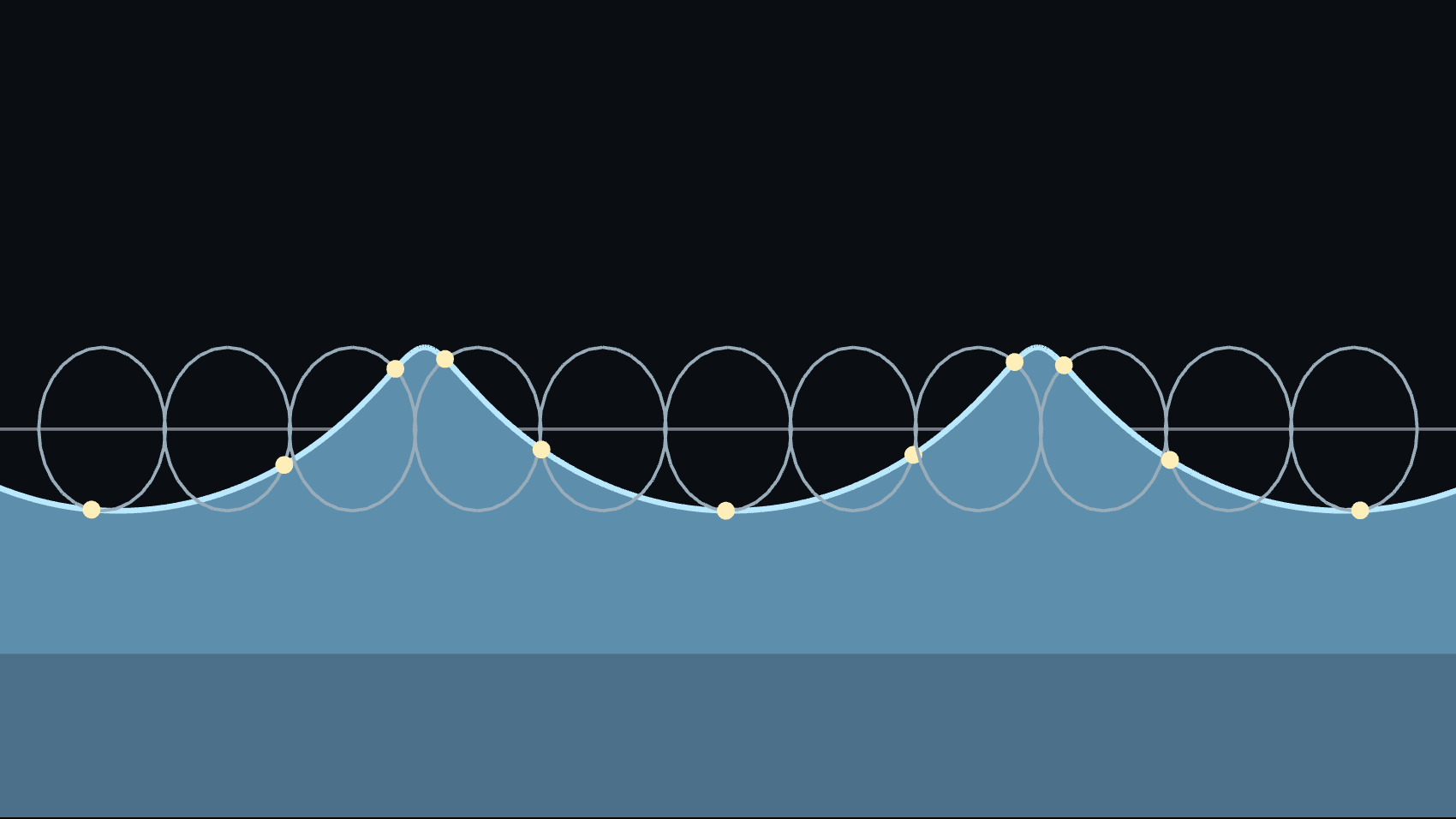
How it worksA simple height-field wave moves water straight up and down, so its crests and troughs are mirror images — smooth sine curves. Real swell isn't symmetric. The fix (Gerstner, 1802) is to displace each surface point horizontally as well as vertically, by the same wave but a quarter-cycle out of phase: every point traces a little closed loop as the wave passes — an ellipse, and a true circle when the sideways and up-down motion match — and because those loops bunch the points toward the crests, the peaks pinch up and the troughs flatten out. Steepness is how wide the loops are; at zero you get a pure sine, and as it grows the crests sharpen until — pushed too far — the loops would cross and the surface breaks. Switch to Ocean to sum a few waves of different wavelengths (each moving at its own √(g·k) speed) into a believable sea; the single wave shows the orbit each point follows, the bright line the surface they shape.